IT CAN’T HAPPEN HERE
A BIOGRAPHICAL NOTE
Sinclair Lewis was born in Sauk Centre, Minnesota in 1885, dying in Rome, Italy in 1951. Another Yale grad, he struggled to establish a journalistic career in Waterloo, Iowa, Carmel and San Francisco, California and New York City. Moving to Washington, D.C. to attempt fiction-writing full-time, he achieved phenomenal breakthrough success with his 1920 publication of Main Street. This novel sold two million copies within the first year, converting its fledgling author into an instant millionaire.
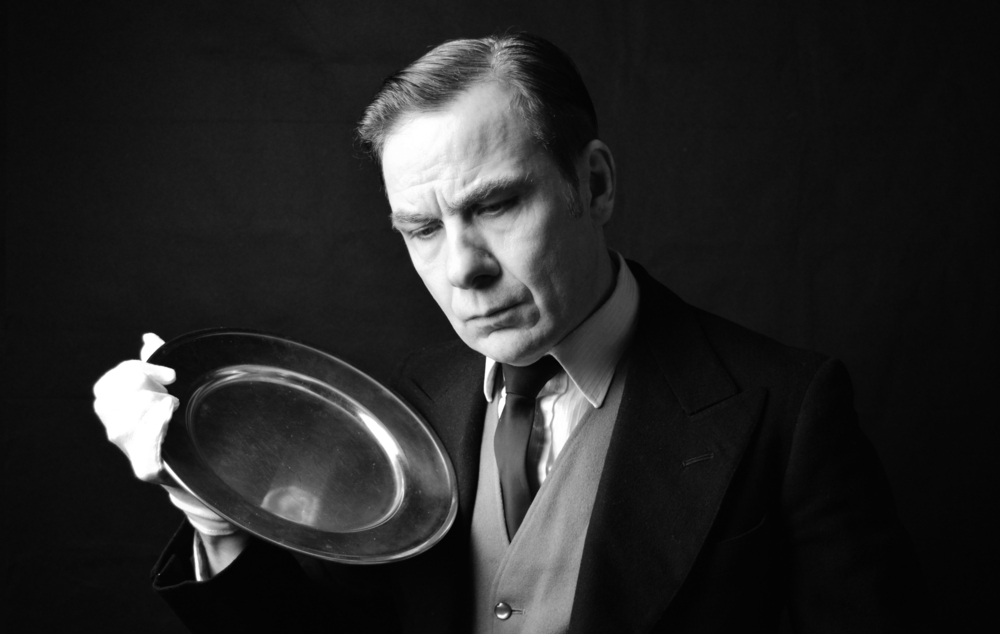
Over his 30-year career, Lewis produced five more national best-sellers: Babbitt, Arrowsmith, Elmer Gantry, Dodsworth and It Can’t Happen Here. His books were adapted for stage and screen, generating multiple Academy Awards. He won a Pulitzer and was the first American to be honored with the Nobel Prize for Literature.
Lewis’s fiction was domestic, grounded and realistic; emphasizing political, economic and cultural conflicts — regional, urban/rural, class, religious and racial.
Despite their consistent marketability, his books never received much approval by America’s academic literati. They were dismissed as lacking sophistication, art and style. I distinctly recall, as a Yale English major in the sixties, that Lewis was never seriously studied. Fitzgerald and Hemmingway were admired but fading; Faulkner was king. Now, after decades of relegation, Lewis’s creations are being re-acknowledged, especially the novel that’s the subject of this post. Donald Trump is its unwitting publicist.
HISTORICAL FICTION: A DOMESTIC DICTATORSHIP TAKES OVER AMERICA
It Can’t Happen Here imagines the subjugation of American democracy by a home-grown dictatorship. The coup becomes all-consuming but begins almost unnoticed, misperceived as the normal tussle of competitive partisan politics.
Lewis’s protagonist is well-placed to track and narrate this drama on three levels. Doremus Jessup is the father of three civically-active adult children. The owner and publisher of a Vermont newspaper, he’s plugged into his local business community and a member of Rotary. As an experienced journalist and editor, he astutely follows, reports and comments on state and national affairs.
On the Hustings
The year is 1936. Two champions and two parties are contesting for the American presidency: incumbent Franklin D. Roosevelt for the Democrats; challenger Walt Trowbridge for the Republicans. The Great Depression is dragging on, intensifying potential voters’ desperation. Virtually out of nowhere emerges an electoral skyrocket determined to deny Roosevelt the Democratic nomination.
Senator Berzelius (“Buzz”) Windrip is not a complete unknown, but he’s a state and regional figure, not a national headliner. Doremus sketches an ironic profile:
As the November 1936 election approaches, journalists and commentators speculate which platform pillar – Relief, Populism or Control – might capture a victorious Windrip’s priority attention. He does not keep them guessing.
Fast Out of the Gate
In the first hours following his Inauguration, the new President upgrades the Minute Men. Organized by him during the campaign as a patriotic marching club, the Minute Men are now formally promoted to a paramilitary force commanded by the President’s eminence grise, Lee Sarason. Their military training and equipping have already been advancing in secret.
On the same day, the President issues a written demand to Congress to immediately enact legislation approving his platform’s signature plank, giving him comprehensive control of government. Stunned but rallying, both chambers reject this proposed seizure of power. Whereupon, the President orders the Minute Men to incarcerate the Congress, arresting active opponents and “protecting” moderates. A protest mob proceeds to the Washington, D.C. jail where the legislators are being held. The President exhorts the Minute Men, who shoot and disperse the protestors. An intimidated Congress enacts the stalled legislation. Four liberal Supreme Court justices resign. An emboldened President assures the nation by radio that a combined Wall Street/Russian insurrection has been thwarted, and that his new Administration has launched historic reforms.
Lee Sarason is appointed Secretary of State. Other campaign loyalists fill out the Cabinet. Bishop Prang protests the Executive Branch heavy-handedness and is sequestered on medical grounds.
With consolidation-of-control occupying the President’s full attention, the Relief plank’s promised stipends are indefinitely postponed. Instead, National Labor Camps are established to offer work, room and board to the unemployed and their families.
Institutional reconfigurations take two principal forms. The Democratic and Republican Parties are consolidated into a melded Corpo Party headed by the President. And the 48 States are replaced by six regional Provinces, each headed by a presidentially appointed Governor-General and Commission.
Elite private universities are dissolved, replaced by presidentially created and staffed “Pioneer Universities,” focusing on patriotic inspiration and technical training.
Radio stations, newspapers and magazines are encouraged to publish stories praising the government’s reform achievements. Explicit censorship is initially avoided, but on-site monitors ensure respectful compliance.
Overt criticism of or opposition to the President is swiftly criminalized with sedition prosecutions by ad hoc tribunals. Convicted offenders (there are no acquittals) are dispatched to provincial Concentration Camps. There, Minute Men jailers maintain arduous conditions, including beatings and physical torture designed to extract betrayals of the prisoners’ at-large associates. (As one such “enemy of the state,” Doremus shares a 10’x12’ cell with five other inmates and is forced to observe the execution by firing squad of his son-in-law.)
As the Great Depression fails to yield to the President’s nationalistic reforms, the Administration launches an unprovoked war against neighboring Mexico. The public justifications are patriotism and Manifest Destiny. The covert agenda is saber-rattling distraction.
Despite continuing economic adversity and repeated evidence of the new Administration’s ineptitude, no effective political opposition mobilizes. Citizens are justifiably intimidated by governmental spies and violence. America has no recent tradition of armed insurrection.
Having declined Windrip’s insulting appointment as a third-tier ambassador, Franklin Roosevelt retreats to his Hyde Park estate. Eluding Minute-Man surveillance, former Republican candidate Walt Trowbridge escapes by small plane across the sealed Canadian border and is granted political asylum in Toronto. There he launches a New Underground, producing and distributing anti-Windrip propaganda. (In a poignant chapter, the author profiles American refugees parked in Montreal cafes, interminably reciting personal sagas like White Russians in Paris after the Bolshevik Revolution. Their Canadian hosts are patiently sympathetic but increasingly bored.)
A few brave activists join the pamphleteering Resistance. A comparable few opportunists seek security and income as provincial officers of the authoritarian regime. High-profile government opponents are imprisoned and often executed. The majority of skilled workers relocate with their families to National Labor Camps. Almost all professionals – doctors, lawyers and engineers, priests and professors – keep their heads down and their mouths shut.
If I haven’t already told you too much, interested blog readers can discover the climax and denouement of this saga for yourselves by visiting Amazon or your local libraries.
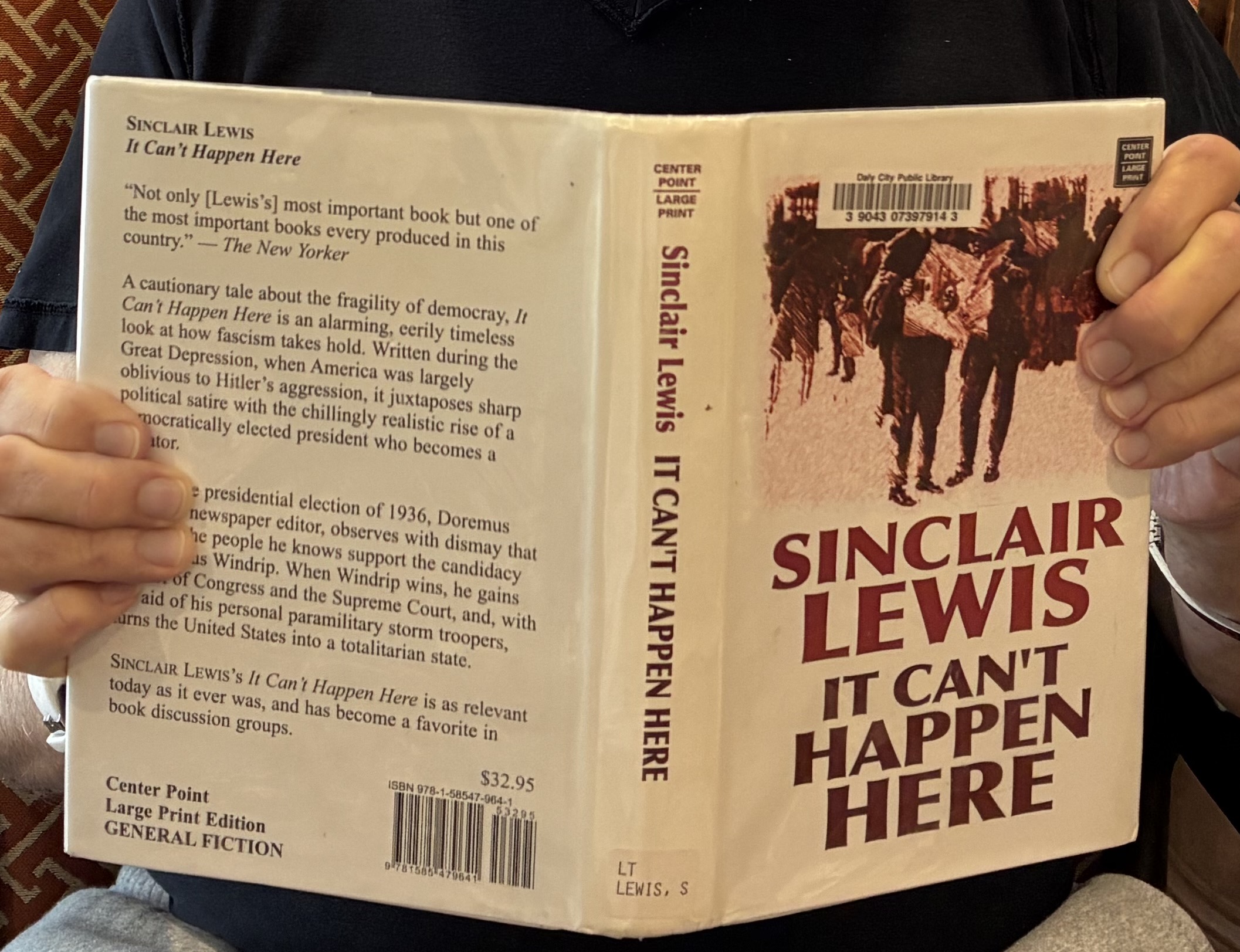 LIFE IMITATING ART
Thousands of good books are published in the United States every year. Fiction and non-fiction. Why would you read a political novel written 90 years ago?
For one thing, a contemporary account of historic developments packs a potent punch. What did it feel like to experience and endure the Great Depression?
For another, this novel was well-crafted and well-timed. I already mentioned how the protagonist’s three roles – as parent, local business owner and journalist – enrich the coverage of his narration. A 1935 publication date was optimal for a fictionalized expose of America’s vulnerability to authoritarianism. Hitler had just forcibly transformed the German government from democracy to totalitarian dictatorship. Mussolini was invading Abyssinia (Ethiopia). Franklin Roosevelt would be defending his expansive New Deal in the 1936 presidential election. And to deliberately link his fictional scenario to current events, Lewis peppered his cast with actual celebrities: Roosevelt, Hoover, Frances Perkins, Father Coughlin, even heavyweight boxing champion Primo Carnera.
This is a credible thriller tracking American democracy under siege from within.
Then and Now
Of course, It Can’t Happen Here’s most compelling allure for modern readers springs from its remarkable resonances with our own current political crisis. Most of the parallels are analogues, not exact duplicates. But Lewis’s main themes and plot developments are recognizable:
- A charismatic outsider perceives public discontent and ambushes a conventional bipartisan national election.
- A sizeable portion of the aggrieved electorate embraces the newcomer and his capacity to generate change with a fervor approaching a personality cult.
- The new leader secures their allegiance by promoting a populist manifesto promising restoration of his base’s prior privileges (real or imagined) and punishment of minority enemies.
- Powerful interest groups exploit the populist agenda to advance their own priorities – especially big business and Christian religious denominations. These lobbies quietly support the disruptor with financing and advocacy
- The leader deploys an armed paramilitary force as a violent personal militia.
- His political opponents are coopted, intimidated and persecuted.
- Political partisanship and paralysis prevent Congress from effectively resisting presidential consolidation of power, neutralizing constitutional checks and balances.
- Political parties and the press are subverted from performing their traditional roles.
- When domestic initiatives falter, the new leader and his administration launch foreign wars as patriotic distractions.
Yesterday’s Pointers for Today and Tomorrow?
It Can’t Happen Here was a fictional story, not a seminar syllabus. But its subject was deadly serious. Lewis was using his cumulative professional experience to send clear warnings about the threat of authoritarianism to American democracy. What are some implicit pointers we can take away, adapt and apply?
- Authoritarianism has a long and broad international history. Don’t arrogantly assume that America enjoys unique immunity.
- If a presidential candidate or incumbent offers all voters annual cash grants (or tax breaks) in exchange for unprecedented Executive authority, don’t be surprised which side of this bargain receives his implementation priority.
- Beware when a presidentially created patriotic marching society is issued side-arms or when his paramilitary posse appears in masks.
- Be alarmed when a president convenes ad hoc tribunals to investigate and criminally prosecute political opponents and journalists.
- Listen up when a national leader claims that “the other” are responsible for causing domestic economic, political or social problems. [Insert Negroes, Jews, Communists, radical unionists, immigrants, Muslims, or elites.]
- Governing any democracy is a complex, constantly changing, public-sector-management responsibility. Be highly skeptical of any savior who boasts he can handle it alone.
- Raise your hackles whenever a president replaces experienced professionals in top Administration positions with unquestioning loyalists, business associates or family members.
- Pay attention whenever a president claims that national emergencies demand immediate, unilateral Executive authority.
Lewis’s democracy-defending focus was on a new, opportunistic demagogue sweeping into the presidency and sprinting to consolidate power. Our own sequential challenge is how to depose or at least defang an impulsively expansive incumbent. This rule-breaking narcissist is unlikely to retire voluntarily.
An authoritarian coup can happen here. It already is happening. Stay tuned, stand up and speak out.