LISTENING TO BOOKS
Part Two: Searching for the Best
LITERARY CLASSICS
Socerers’ Apprentices
At the beginning of my sophomore year at Yale, I was invited to join a seminar in my new residential college. (Yale’s 12 colleges, like Harvard’s houses, were derivations of Oxford and Cambridge precedents. Designed to introduce a human scale into the sprawling university campus, each of these neighborhood centers encompassed housing for sophomores through seniors, a dining hall and library, intramural sports teams and resident faculty members called Fellows. I’ve always appreciated Yale’s policy requiring all professors, no matter how elevated, to devote part of their professional time to teaching undergraduates.
This particular seminar assembled eight sophomores to meet weekly in the paneled study of William Wimsatt, a ranking pillar of the University’s English Literature Department. The free-ranging seminar subject was critically reading literature. Because Wimsatt was so esteemed by his peers, our sessions attracted a flow of literary luminaries. W.H. Auden, John Hollander, William Styron and Robert Penn Warren all pulled up a chair around our discussion table.
Harold Bloom was a more regular visitor. His participation was somewhat surprising; he and Wimsatt made an odd academic couple. Wimsatt was my parents’ age, in his mid-fifties, nearly seven feet tall, reserved and shy. Bloom was the Department’s wunderkind, just turned 30, ebullient and already on his way to Falstaffian rotundity. More curious for their pairing, Bloom was building his academic career with published opposition to Wimsatt’s signature scholarship. As a founding principal of the New Criticism movement, Wimsatt advocated evaluating literary compositions as stand-alone works of art, without reference to their authors’ resumes or intentions. Bloom insisted that biographies were central to informed criticism. Despite this public contest, it was soon evident around our table that these two scholars enjoyed a close professional and personal relationship. (Bloom later dedicated his most heralded book to this mentor.)
Both of them demonstrated profound knowledge of major authors and their works (poems, prose and dramas). And a constant dedication to close reading of texts: their meaning and nuances, vocabulary, context and contributions within larger works. For our octet of 19-year-old aspiring English Majors, these exchanges were a hands-on workshop. We were expected not merely to listen but to ask and answer questions, backing up our analyses with informed arguments, including deciphering antique usage. The disciplined practice was demanding but exhilarating.
Bloom’s deference to his mentor was consistent. But his quiet brilliance was electric. At ease with his eidetic memory, he had all of Paradise Lost’s 1,000 lines on the tip of his tongue.
The young scholar went on to an illustrious career. He climbed to a Sterling Professorship, Yale’s highest academic rank. He published 50 books and was awarded a MacArthur “genius” Fellowship. Last month, a New York Times Book Review cover story lauded him as “one of America’s most influential intellects.”
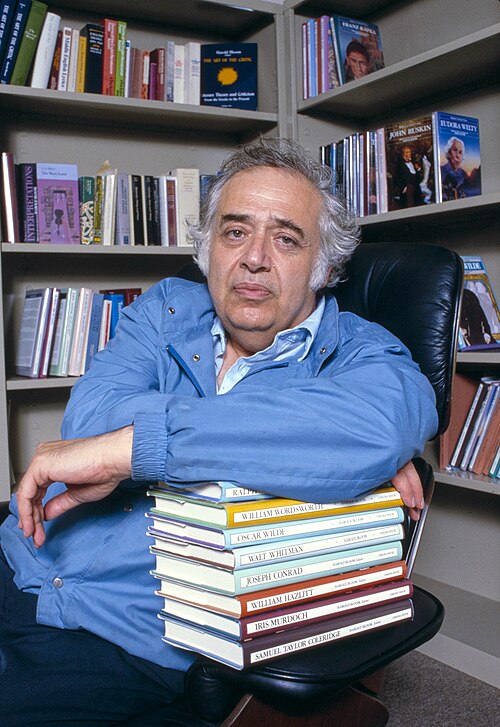
https://en.wikipedia.org/wiki/Harold_Bloom
Pulling It All Together
The most recent biography of Harold Bloom is titled The Man Who Read Everything. In 1994, Bloom pulled together his encyclopedic knowledge of European and American literature in a comprehensive celebration of masterworks entitled The Western Canon. His massive compendium focuses on English-language texts but expands that scope to encompass works in other European languages that have been translated into English. “European” is likewise expanded to include English-language writers scattered worldwide through former British colonies. Apart from brief consideration of Classical Greek and Roman authors, Bloom’s main chronological sweep spans the 15th through the 20th centuries: “from Dante to Beckett.” I welcomed this iconic volume as my one-stop-shop for literary classics.
Bloom’s roster assigns great authors to two tiers: an inner circle of 26 supreme paragons, with William Shakespeare in the Number 1 slot; and 500 lesser literary heroes. He utilizes three main criteria to set the entry standard for the inner circle: creative genius; originality of presentation, style and content; and breadth and duration of influence on subsequent writers. Here’s his Best of the Best, in chronological order:
Dante Alighieri
Geoffrey Chaucer
Miguel de Cervantes
Michel de Montaigne
William Shakespeare
John Milton
Moliere
Samuel Johnson
Johann Goethe
William Wordsworth
Jane Austen
Charles Dickens
Walt Whitman
George Eliot
Emily Dickenson
Henrik Ibsen
Leo Tolstoy
Sigmund Freud
Marcel Proust
Virginia Woolf
James Joyce
Franz Kafka
Fernando Pessoa
Jorge Borges
Pablo Neruda
Samuel Beckett
This is probably an appropriate spot for mentioning that Bloom’s pantheon was harshly condemned by Feminist, African-American and Marxist critics for being obsolete, sexist, racist and reactionary. He enthusiastically joined this public debate, insisting that literary criticism should be aesthetic and artistic, undistorted or compromised by “political ideologies.”
I’d read works by most of these authors at university, including all of Shakespeare’s plays and poetry. But it’s never too late to plug gaps in my literary education. So for my audio selections from this inner circle, I selected a combination of 15 unread masterworks and old favorites I couldn’t resist revisiting: Dante’s Inferno, Cervantes’s Don Quixote, Montaigne’s Essays, Johnson’s Journey to the Western Islands, Goethe’s Faust, Wordsworth’s Through the District of the Lakes, Austen’s Pride and Prejudice, Dickens’s Bleak House, Whitman’s Specimen Days, Eliot’s Middlemarch, Dickenson’s Letters, Tolstoy’s The Cossacks, Kafka’s The Metamorphosis, Borges’s Ficciones and Neruda’s Memoirs.
For my selections from Bloom’s vast second tier of recommended greats, I ranged freely. Even for familiar masters, I sometimes turned to AI to identify authors’ most critically respected works. Here, in chronological order, are the “Top 20” I’ve chosen for listening:
Benvenuto Cellini, Autobiography
Daniel Defoe, Robinson Crusoe
Henry Fielding, The History of Tom Jones
Blaise Pascal, Pensees
Voltaire, Letters on England
Erasmus, In Praise of Folly
Robert Louis Stevenson, The Master of Ballentrae
Fyodor Dostoevsky, The Brothers Karamazov
James Fenimore Cooper, The Deerslayer
Henry David Thoreau, Walden
Francis Parkman, The California and Oregon Trail
Henry James, The Ambassadors
Claude Levi, Tristes Tropiques
Joseph Conrad, Nostromo
Graham Greene, The Power and the Glory
Gunter Grass, The Tin Drum
William Faulkner, The Sound and the Fury
Paul Bowles, The Sheltering Sky
William Styron, The Long March
Ursula K. Le Guin, The Left Hand of Darkness
I’ll doubtlessly return to The Western Canon for more recommendations if I keep this project going for a second year.
CONTEMPORARY PRIZE-WINNERS
To complement the literary classics in my audiobook list, I wanted to collect some top-quality examples of modern fiction and non-fiction.
Recent Fiction
Nancy and I stopped by Barnes & Noble’s sprawling San Jose outlet. While she browsed for a couple of purchases, I chatted with the store manager about my BTBL connection and search for audiobook recommendations. He was delighted by the coincidence and walked me to a nearby display table. He and his senior staff had just completed their own recommendations for top 21st century fiction. He emphasized that their selection criteria had been writing quality and critical awards, not best-sellers. I asked if I could take notes for audiobook borrowing. He encouraged me to jot away.
Here’s Barnes & Noble’s A-List of recommended recent fiction:
Chimomanda Ngozi Adiehie, Americanah
Nana Kwame Adjei-Bremnyah, Chain-Gang All-Stars
Kaveh Akbar, Martyr!
Elif Batuman, The Idiot
Hernan Diaz, Trust
Anthony Doerr, All the Light You Cannot See
Percival Everett, James
Matt Haig, Midnight Library
Kirstin Hannah, The Nightingale
Hannah, The Great Alone
Kazuro Ishiguro, Never Let Me Go
Marjan Kamali, The Lion Women of Tehran
Han Kang, The Vegetarian
Lily King, Writers and Lovers
Barbara Kingsolver, Demon Copperhead
Min Ju Lee, Pachinko
Allen Levi, Theo of Golden
Liz Moore, The God of the Woods
Maggie O’Farrell, Hamnet
Tommy Orange, There, There
Ann Patchett, Bel Canto
Patchett, Tom Lake
Richard Powers, Playground
Taylor Reid, The Seven Husbands of Evelyn Hugo
Sally Rooney, Normal People
Chelsea Summers, A Certain Hunger
Donna Tartt, The Secret History
Tartt, The Goldfinch
Rufi Thorpe, Margo’s Got Money Troubles
Two common features struck me about this array. Its authors were ethnically diverse, probably a deliberate shoppers’ lure in multicultural San Jose. And I’d previously read over half of these works, probably a reflection of the influence of newspaper and magazine book reviews over new-releases scavengers like myself.
I selected seven enticing unread titles to add to my first-year’s audiobook reading list: Bel Canto, Demon Copperhead, Never Let Me Go, Normal People, Playground, Trust and The Vegetarian.
 Current Non-Fiction
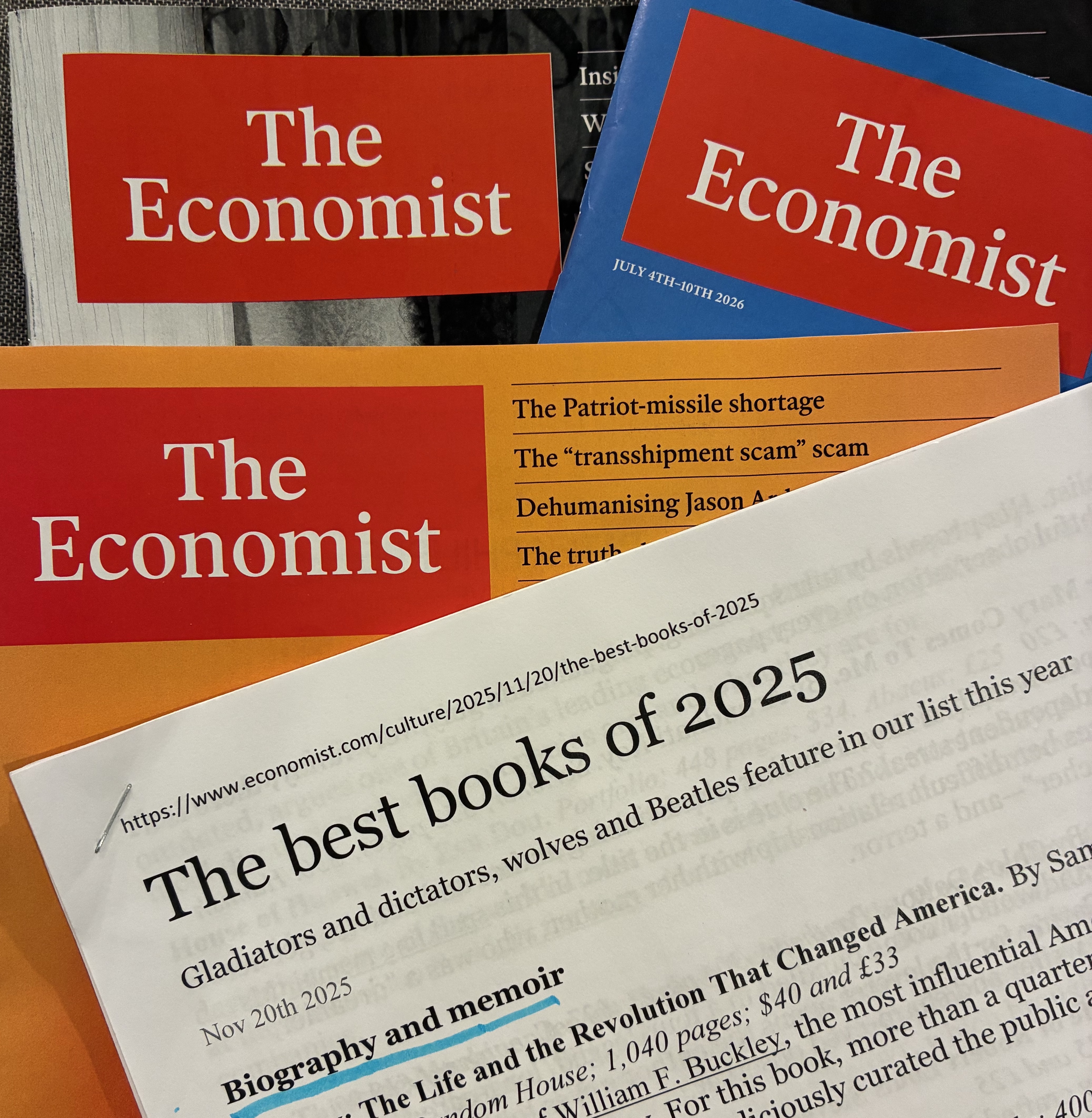
As a reputable source of outstanding contemporary non-fiction, I studied The Economist’s Best Books of 2025. I’ve been an Economist subscriber for decades. I love the weekly’s editorial courage and independence, its investigative reporting, its articulate style, its sardonic wit and graphics and its lyrical obituaries. Even its right-of-center political tilt helps discipline my liberal leanings.
To illustrate my eight choices’ topical range, I’ve matched each with its Economist category. Descriptive tags are added for content not evident from the titles:
Biography
Leo Damrosch, Storyteller: The Life of Robert Louis Stevenson
Business and Economics
Andrew Ross Sorkin, 29 [a retelling of the Great Crash]
Culture and the Arts
Adam Weymouth, Lone Wolf [retracing the 2,000-kilometer, Eastern-European trek of a wild carnivore]
Danny Bate, Why q needs u [a history of writing and biography of the English lanaugage]
History
Harry Sidebottom, Those Who Are About To Die [latest findings about Roman gladiators]
Politics and Current Affairs
Kiernan Mulvaney, Arctic Passages: Ice, Exploration and the Battle for Power at the Top of the World
Science and Technology
Robert Macfarlane, Is A River Alive?
Samnath Subramanian, The Web beneath the Waves: The Fragile Cables That Connect Our World
I took it as an auspicious sign that all of these current publications have already been added to BTBL’s audio collection.
LIFT-OFF
My Literary Classics, Recent Fiction and Current Non-Fiction selections total 50 audiobook titles, right on target for a continuous year of programming. Next, I’ll reconfirm they’re all are in stock and available for borrowing from BTBL. Then I’m ready to start listening. A steady stream of the best books in the world flowing into my living room is a thrilling prospect. And as critic Robert Ebert aptly observed, a great audio-book narrator enhances original print works with voices, accents and drama. Let the shows begin!